
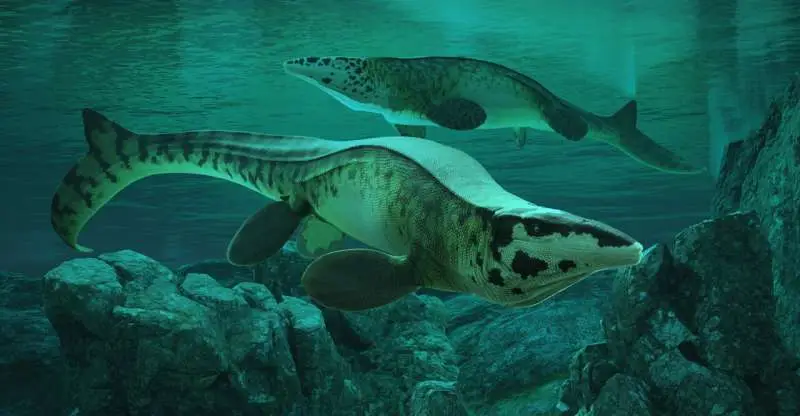
A 43-foot apex predator just got a name worthy of its bite — plus the other paleontology stories worth knowing this year.
Researchers from the American Museum of Natural History, the Perot Museum of Nature and Science, and Southern Methodist University have formally described a new species of mosasaur — a marine reptile that swam alongside the dinosaurs — and given it a name guaranteed to grab attention: Tylosaurus rex.
The study was published May 21 in the Bulletin of the American Museum of Natural History.
Quick clarification: Tylosaurus rex is not a dinosaur. Mosasaurs are marine reptiles more closely related to modern monitor lizards and snakes. They just had the misfortune of sharing a planet with the actual dinosaurs.
The cool facts
- Size: Up to 43 feet (13 meters) long — roughly the length of a school bus and about twice the size of the largest great white sharks alive today.
- Where it lived: The Western Interior Seaway, the shallow inland ocean that split North America in half during the Late Cretaceous. Most fossils were pulled from northern Texas, including the holotype found near Lake Ray Hubbard.
- When it lived: About 80 million years ago, several million years before its land-dwelling namesake stomped onto the scene.
- The weapons: Serrated teeth and bone structures pointing to exceptionally powerful jaw and neck muscles — built for crushing skulls, not just biting.
- It fought its own kind: One specimen, nicknamed “The Black Knight,” was found with a shattered lower jaw and snout damage. Researchers think the only thing capable of inflicting those injuries was another Tylosaurus rex.
- The name story: Back in the 1960s, SMU paleontologist John Thurmond noticed these Texas tylosaurs were unusually huge and informally called them Tylosaurus thalassotyrannus — “sea tyrant.” Decades later, co-author Amelia Zietlow floated “T. rex” to colleague Mike Polcyn as a joke. He laughed, then agreed. The name “Tylosaurus rex” translates to “king of the knob lizards,” mirroring T. rex’s “king of the tyrant lizards.”
- Why it matters scientifically: The description forces a rethink of how giant mosasaurs are classified, since many older studies relied on decades-old fossil datasets.
Why two “T. rex”s isn’t as weird as it sounds
The land-dwelling Tyrannosaurus rex almost wasn’t called T. rex at all. In 1892, paleontologist Edward Cope described two partial backbones from South Dakota and named the animal Manospondylus gigas. When those bones were later linked to T. rex, the new name was already too embedded in the literature — and the public imagination — to dislodge.
So now we have two T. rexes. The taxonomic naming rules technically allow it, since they’re different genera. Paleontologists seem delighted by this.
A timeline of the find
Late 1960s John Thurmond at SMU notices Texas tylosaur fossils are unusually large; informally dubs them T. thalassotyrannus — “sea tyrant.”
2000s–2020s Most of the specimens now used to define the species are unearthed in North Texas over the last 15–20 years.
Recent years Mike Polcyn stumbles across Thurmond’s old note while looking for something unrelated. “It was serendipity,” he told the Dallas Morning News.
May 21, 2026 Formal description published; Tylosaurus rex officially joins the books.
What else paleontology has been up to in 2026
Tylosaurus rex isn’t an outlier — paleontology is having something of a golden age, with new fossil descriptions appearing roughly every ten days. A few highlights from the past several months:
- Spinosaurus mirabilis (February 2026) — A new “scimitar-crested” Spinosaurus species described from a skull found in the Farak Formation of Niger, in a dig site that had been largely forgotten for 70 years. Published in Science by Paul Sereno’s team. Show Image
- Doolysaurus huhmin (March 2026) — A fuzzy baby dinosaur fossil found on South Korea’s Aphae Island, the country’s first dinosaur fossil discovery in over 15 years.
- Bicharracosaurus dionidei (May 2026) — A bizarre 20-meter giant from Argentina that’s reshaping how paleontologists understand the evolution of Southern Hemisphere Jurassic titans.
- “Last titan” of Thailand (May 2026) — The longest-necked dinosaur ever found in Southeast Asia.
- Organic molecules in 66-million-year-old bones (May 2026) — University of Liverpool researchers found strong evidence of original collagen surviving in Edmontosaurus bones, bolstering a controversial idea that’s divided paleontologists for 30 years.
- A new “mini-T. rex” debate — Recent work on the “dueling dinosaurs” fossil suggests Nanotyrannus is its own species, not just a juvenile Tyrannosaurus rex.
The Takeaway
The most striking thing about the Tylosaurus rex story isn’t the size or the teeth — it’s how much of the work happened in museum drawers. Most of the fossils have been sitting in collections for years or decades. A note from the 1960s sparked the name. As Perot Museum researchers put it, this is why it pays to keep doing science: sometimes the next big discovery is already in the building, waiting for someone to look again.
Sources: American Museum of Natural History via ScienceDaily; National Geographic; Smithsonian Magazine; Live Science; Perot Museum / WFAA; Dexerto; University of Chicago News.