The Tailor Who Saved George Washington
“This man is a true friend of liberty.” — George Washington, on Hercules Mulligan, allegedly spoken over breakfast on Wall Street the morning after the British evacuated New York
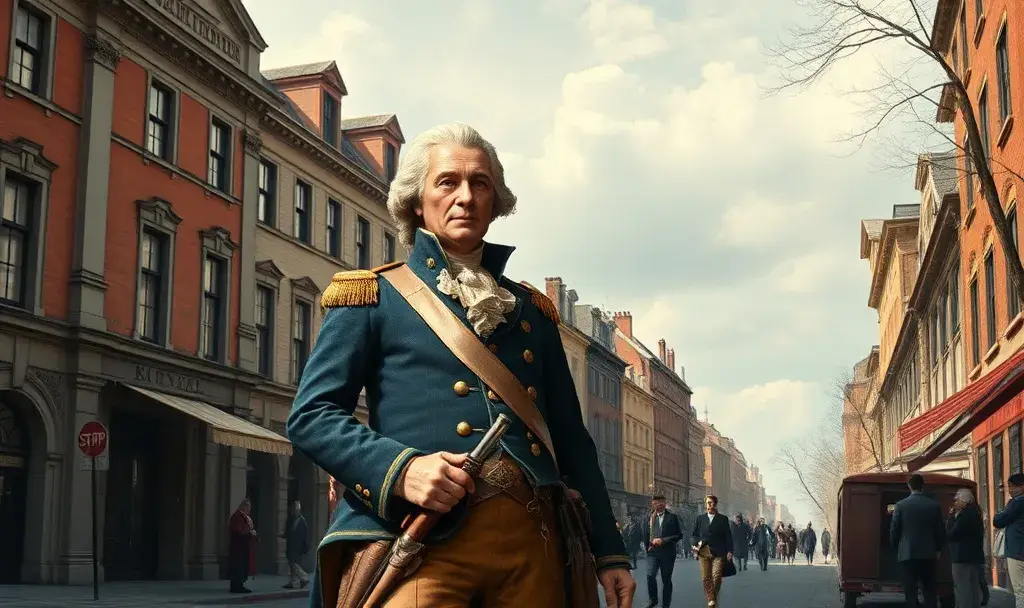
In November of 1783, the British army finally sailed out of New York Harbor, ending seven years of occupation. The next morning, General George Washington — the most famous man in the new United States, the conquering hero of a war that should have ended his life on a gallows — walked into a tailor’s shop on Queen Street and asked for breakfast.
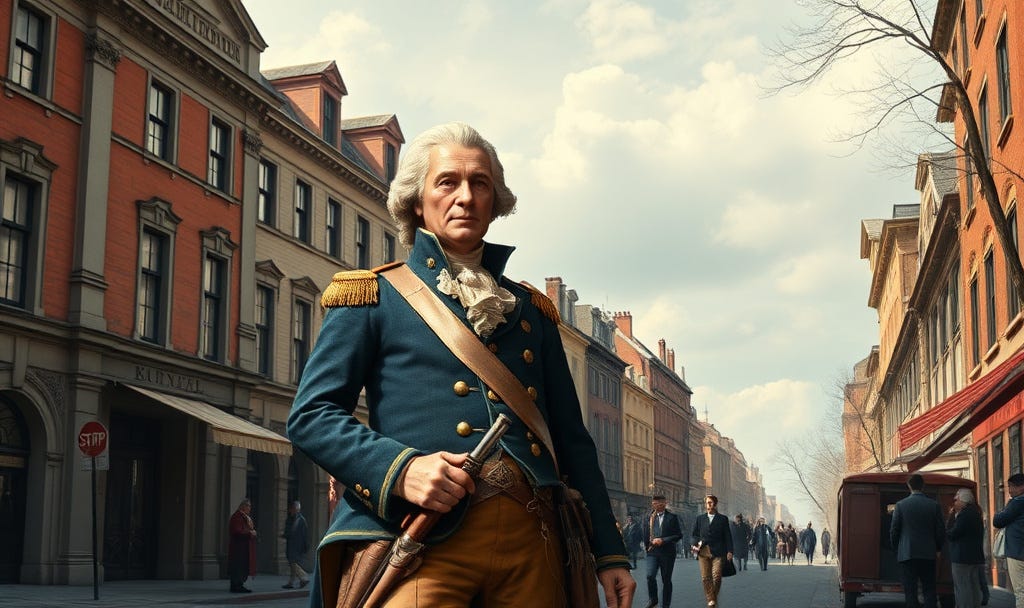
This was not a coincidence, no casual stop. This was a public, deliberate, and extremely awkward performance, because the tailor in question, one Hercules Mulligan, was widely suspected by his neighbors of being a Tory collaborator, a British sympathizer, and a possible coward.
He was, in fact, the single most effective spy in the entire Continental intelligence apparatus. He had personally saved Washington’s life at least twice. And nobody — not his neighbors, not the British officers who’d been his customers for seven years, not even most of Washington’s own staff — had any idea.
This is the story of how a man named Hercules, who sewed pants for a living, helped win the American Revolution.
An Irish Immigrant With Excellent Taste
Hercules Mulligan was born in 1740 in Coleraine, Ireland, and emigrated to New York with his family as a child. His father started a small accounting business; Hercules went to King’s College (now Columbia), which was, at the time, the kind of institution that produced exactly the sort of well-connected young men who would later run a revolution.
By his thirties, Mulligan had set up shop as a tailor — and not just any tailor. He was the tailor in New York. If you were rich, fashionable, British, or aspiring to be any of those three, you went to Hercules Mulligan to be measured for a suit. His client list read like a directory of colonial high society, and would shortly read like a directory of British military command.
In 1772, a teenage immigrant from the Caribbean arrived in New York with a letter of introduction. He needed a place to stay while he figured out how to get into King’s College. Mulligan took him in. The teenager’s name was Alexander Hamilton.
This is, genuinely, how history works sometimes. The future first Secretary of the Treasury spent his first American years sleeping in the back room of a tailor shop, listening to the proprietor — a charismatic Irishman twenty-five years his senior — explain at length why the British were tyrants and the colonies should revolt. By the time Hamilton matriculated, he was a committed revolutionary. Mulligan would later claim, with some justification, that he had “made” Hamilton. The historical record, for once, mostly agrees.
The Sons of Liberty’s Best-Dressed Member
Mulligan was an early and active member of the Sons of Liberty, the proto-revolutionary group best known for the Boston Tea Party and for being, by 18th-century standards, a fairly rowdy bunch. He helped tear down a statue of King George III in 1776 — the lead was melted into musket balls — and was briefly imprisoned by the British when they took New York later that year.
And here is where the story takes its strange turn. Upon his release, Mulligan did not flee the city. He did not join the Continental Army. He went back to his shop, reopened for business, and began enthusiastically taking measurements for British officers.
To his neighbors, this looked like capitulation, or worse. To Alexander Hamilton — now an aide-de-camp to General Washington — it looked like an opportunity.
How to Spy on an Army by Hemming Their Pants
The British officer corps in occupied New York had a problem they didn’t know was a problem: they needed clothes. Wool uniforms wore out. Buttons fell off. Officers attending balls needed civilian coats. And the best tailor in the city was a charming, talkative Irishman who never seemed to talk politics and who poured a generous glass of port while you waited for your fitting.
Officers told their tailor things. They told him where they were being deployed. They told him about troop movements, supply shortages, planned raids. They complained about their commanders. They bragged about upcoming operations. Mulligan listened, smiled, took measurements, and at night passed the information — through a network that included his enslaved servant Cato, who traveled in and out of the city carrying messages — directly to Washington’s headquarters.
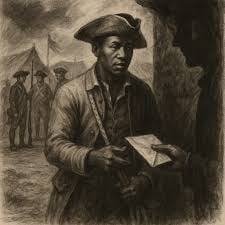
This intelligence was good. Specific. Timely. Actionable.
In 1779, Mulligan learned that the British were planning to kidnap Washington during an upcoming trip. He got word out in time. The trip was canceled. Washington lived.
In 1781, a British officer came in for an urgent late-night order: he needed a coat by morning, because he was riding out at dawn on a mission to capture Washington in Connecticut. Mulligan finished the coat, sent his brother to ride through the night to Continental lines, and Washington was warned in time to evade the trap. Washington lived. Again.
There is no way to know exactly how many times Hercules Mulligan’s needle and thread saved the war. The British, who never figured him out, kept buying their uniforms from him until the day they left.
The Breakfast
When the British finally evacuated in November 1783, Mulligan’s neighbors were ready to ostracize, denounce, or possibly tar and feather him. He had, after all, been the British army’s favorite tailor for seven straight years.
This was the problem Washington solved over breakfast.
The morning after the British departure, Washington — who had been briefed by Hamilton on exactly what Mulligan had done — walked into the shop on Queen Street, in full view of the city, sat down for a long and visible meal, and reportedly toasted his host as “a true friend of liberty.” He then commissioned Mulligan to make his civilian suits for the rest of his life, a public endorsement that was, in effect, a full pardon, a security clearance, and a five-star Yelp review delivered simultaneously.
Mulligan put a new sign over his shop. It read: Clothier to General Washington.
He used it for the next forty years.
The Quiet Ending
Mulligan lived until 1825, dying at the age of 84 in the same city he had spied for, tailored for, and helped liberate. He was buried in Trinity Churchyard in lower Manhattan — the same churchyard where Alexander Hamilton, killed two decades earlier in a duel with Aaron Burr, also lies.
For most of the next 180 years, he was almost entirely forgotten outside of specialist historical circles. His name surfaced occasionally in footnotes about Hamilton’s early life, or in obscure histories of Revolutionary espionage, and then submerged again. It took a Broadway musical, of all things, to drag him briefly back into public memory in 2015.
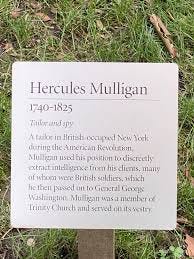
There is no statue. There is no movie. There is a small plaque in the churchyard, and a sign at the site of his old shop, and not much else.
He saved the founding father of the country twice. He gets a footnote.
🧵 Trade Corner: Why Was a Tailor Such a Useful Spy?
It is tempting to read the Mulligan story as a fluke — a guy who happened to be in the right place at the right time. But there’s something more structural going on, and it’s worth thinking about why a tailor, specifically, was so devastatingly effective.
Three things came together:
- A fitting is an intimate, low-guard environment. You are standing still, half-dressed, often for an hour or more. The tailor is on his knees with a mouthful of pins. He is, by social convention, a servant — beneath your notice. People say astonishing things in front of people they don’t see. Officers who would have died before discussing operations in front of a fellow soldier said them freely to the man hemming their trousers.
- Tailors had legitimate reasons to ask questions. “Will you need this for the winter campaign or the spring?” “Should we line it heavier — I hear you may be posted north?” “How many extra buttons — are your men with you?” These are not interrogation questions. They are fitting questions. Mulligan could ask things a spy could never get away with asking.
- The British had no model for the threat. Eighteenth-century military intelligence assumed spies were officers, diplomats, or paid informants — men with rank, motive, and access. The idea that a tradesman — an Irishman, no less, of no social standing — could be running a high-level intelligence operation out of a Queen Street shop was, to the British command, almost literally unthinkable. They didn’t catch Mulligan because they were not, in any meaningful sense, looking.
There is a lesson here that has nothing to do with the Revolution and everything to do with how power overlooks the people who serve it. The British lost the war for many reasons. One of them was that they assumed the man with the pincushion didn’t matter.
He did.
Next week: the formerly enslaved deputy marshal who arrested 3,000 outlaws and may have been the real Lone Ranger.