
The 8th Grade Dropout Who Cooked America
“The educated man is one who has so developed the faculties of his mind that he can acquire anything he wants.” — Percy Spencer, who had a fifth-grade education and 300 patents
Achocolate bar melted in Percy Spencer’s pants in 1945, and that is how we got the microwave oven.
That is not a metaphor. That is not a simplification. That is, almost word for word, what happened. A man with a fifth-grade education was standing in front of a piece of military radar equipment, felt something warm and unpleasant near his thigh, and instead of stepping away—as any reasonable adult would—sent an intern out for popcorn kernels.
By the next morning, he had also exploded an egg in a colleague’s face. By the end of the decade, he had patented a kitchen appliance that now sits in roughly 90% of American homes. By the end of his life, he had 300 patents, an honorary doctorate, and a Navy citation—and almost nobody outside of Raytheon’s HR department knew his name.
This is the story of Percy Spencer, the most prolific, accomplished American inventor you’ve never heard of.
A Childhood Designed by a Pessimistic Novelist
Percy Spencer was born in 1894 in Howland, Maine, a town so small it makes “rural” feel like an overstatement. His father died when he was 18 months old. His mother, apparently deciding that single parenthood was not for her, promptly handed him off to an aunt and uncle and exited the story. His uncle then died when Percy was seven.
By the age of twelve, Spencer had left grammar school to work at a spool mill, twelve hours a day, six days a week. His formal education ended somewhere around the fifth grade, give or take.
This is the part of the biography where, in a normal life, the camera would pan away and we’d accept that Percy was destined for a quiet existence of manual labor and early-onset arthritis. Instead, at sixteen, Percy heard that a nearby paper mill was being electrified — a novelty at the time — and decided he would become one of the three men hired to install the electrical system.
There were two minor obstacles: he had never seen electricity, and he knew nothing about it. He taught himself. He got the job.
The Navy, Which Did Not Know What to Do With Him

In 1912, Spencer heard about the Titanic and was so taken with the role wireless operators had played in the rescue that he joined the Navy specifically to learn radio. The Navy, presumably expecting a recruit who could read at a high school level, was confronted with a teenager who could not, but who insisted on being taught wireless telegraphy.
So Percy taught himself. Again. He stood watch at night and read textbooks on trigonometry, calculus, chemistry, physics, and metallurgy by the light of a single bulb. He read every technical book the Navy library had. By the time he left the service, he was — by any meaningful definition — a physicist. He just didn’t have the paperwork.
This would become a recurring theme.
Raytheon, Radar, and Why the British Were Very Happy
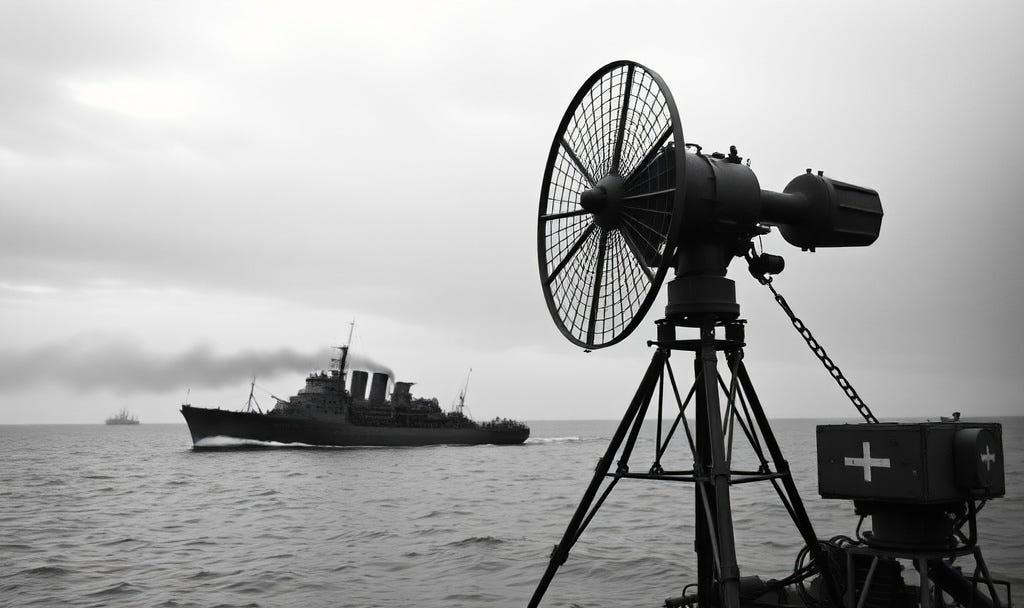
Spencer joined a small Massachusetts company called Raytheon in 1925, when it had about a dozen employees. By World War II, he was running the power tube division, and Raytheon was making the magnetrons that powered Allied radar.
A magnetron is, roughly, a device that produces microwaves. In 1940, the British had invented a powerful new version but could only build them at a rate of about 17 per day, using a painstaking machining process. Spencer looked at the design and figured out how to stamp them out of thin metal sheets, like cookie cutters. Production at Raytheon jumped to 2,600 per day.
It is not an exaggeration to say this helped win the war. Radar detected U-boats. Radar guided bombers. Radar warned of incoming aircraft. And Percy Spencer, fifth-grade education, was the man who figured out how to mass-produce the thing that made all of it possible. He was awarded the Distinguished Public Service Award by the Navy, the highest honor the Navy can give a civilian.
The Chocolate Bar
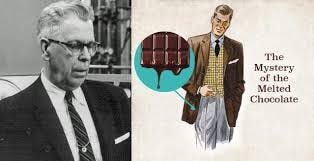
In 1945, Spencer was standing in front of an active magnetron at the Raytheon lab. He had a peanut cluster bar in his pocket — Spencer was a notorious chocolate-feeder of squirrels and apparently kept candy on his person at all times. He noticed the chocolate had turned into a warm, gooey mess.
A normal person would have thought: I should not stand so close to military equipment with snacks. Spencer thought: what else can I melt?
He sent out for a bag of unpopped popcorn kernels. They popped, scattering across the lab. The next morning, he brought in an egg, set it near the magnetron, and watched it explode in a colleague’s face. (The colleague’s name was reportedly recorded; history has been merciful and forgotten it.)
Spencer had realized something that, in retrospect, hundreds of radar engineers should have realized first: microwaves cook food. The early “Radarange,” released in 1947, weighed 750 pounds, stood nearly six feet tall, and cost the equivalent of about $70,000 in today’s money. It was water-cooled. You could not have fit it in a kitchen without removing a wall
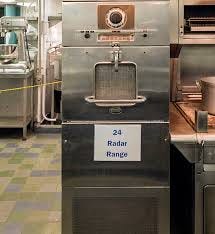
.It would take another twenty years before someone figured out how to shrink it down to the countertop appliance we know today — but the principle, the patent, and the chocolate bar were all Percy’s.
The Patents
Spencer eventually accumulated about 300 patents. He became a senior vice president and a member of the board of directors at Raytheon. MIT, an institution that requires its faculty to have, at minimum, attended high school, made him a Fellow of the American Academy of Arts and Sciences. He was given an honorary doctorate by the University of Massachusetts.
When asked, late in life, how he had managed to do all of this without a formal education, Spencer reportedly answered with a shrug, saying something to the effect of: he just read books.
He died in 1970. There is a building named after him at Raytheon, and a plaque, and very little else. Most Americans have never heard his name. Most Americans use his invention to reheat coffee three times a day.
🔬 Science Corner: How Does a Microwave Actually Work?
The short answer most of us were told as kids — “microwaves vibrate water molecules” — is correct in the way that “a car works because the wheels go around” is correct.
The slightly longer version: a magnetron generates electromagnetic waves at a frequency of about 2.45 gigahertz. This frequency is chosen because it sits in a range that water molecules absorb well, but not so well that the waves only cook the outer layer of food. (A common myth is that 2.45 GHz is the “resonant frequency” of water—it isn’t. Water absorbs across a broad range; the FCC just picked this frequency because it was convenient and didn’t interfere with radio communications.)
Water molecules are polar, meaning one end is slightly positive and the other slightly negative. When you blast them with an oscillating electromagnetic field, they flip back and forth trying to align with it—about 2.45 billion times per second. That frantic flipping is friction, and friction is heat.
Three pleasing consequences of this:
- Microwaves heat unevenly because the waves form standing patterns inside the oven, with hot spots and cold spots. This is why turntables exist—to drag your food through the hot zones.
- Microwaves can’t penetrate metal, which is why you shouldn’t put a fork in one, and also why the little holes in the door screen work. The wavelength is about 12 centimeters; the holes are about a millimeter. The waves are simply too big to fit through.
- A microwave is basically a leaky radar set. The technology that warned of Nazi bombers and the technology that reheats your leftover pad Thai are, fundamentally, the same machine—separated only by a chocolate bar, a curious mind, and a man the American education system entirely failed to educate.
Subscribe for the entire series! Thank you for reading. Please let me know if there is anyone or any type of information you’d like included in the series.