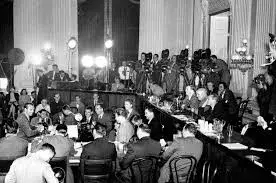
Lovett, Watkins, Sweezy, and the Constitution’s Quiet War on Legislative Targeting
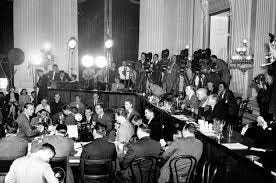
In February 1943, Representative Martin Dies of Texas — chairman of what was then called the House Un-American Activities Committee — rose on the floor of the House of Representatives and read aloud a list of thirty-nine federal employees he accused of being unfit, by reason of their political views, to continue in the service of the United States. He produced no evidence. He filed no charges. He simply read names.
Welcome to the Footnotes is a reader-supported publication. To receive new posts and support my work, consider becoming a free or paid subscriber.
Three of those names were Robert Morss Lovett, Goodwin B. Watson, and William E. Dodd Jr.
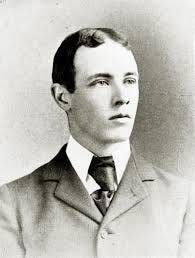
Lovett was seventy-two years old, a Harvard-educated professor of English literature at the University of Chicago, a published novelist, a friend of Jane Addams who had lived at Hull House, and at that moment the Government Secretary of the Virgin Islands — an administrative post in the territorial government to which Franklin Roosevelt had appointed him in 1939. He had committed no crime. His offense, if it could be called that, was a lifetime of progressive associations: petitions signed, organizations joined, essays written, causes supported. The Dies Committee classified roughly two dozen of these organizations as “communist front organizations,” a designation that by 1943 included almost any group that had opposed European fascism before Pearl Harbor or supported labor organizing during the Depression.
Watson was a Columbia psychologist and a founding figure of American social psychology. His federal position was chief analyst at the Foreign Broadcast Intelligence Service of the FCC, where his daily work consisted of analyzing Axis radio propaganda for U.S. wartime intelligence purposes. He was, in the most literal sense, a federal employee whose job was to help the United States understand its enemies.
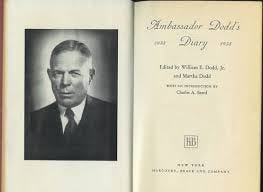
Dodd was thirty-eight, the son of the historian and former Ambassador to Germany William E. Dodd Sr., whose anti-Nazi diary remains a standard primary source on the Nazi rise to power. The younger Dodd worked alongside Watson at the FBIS as assistant news editor. He had been outspokenly anti-fascist in the 1930s, at a time when American anti-fascism overlapped with the political left.
None of the three were charged with a crime. None had refused to cooperate with any investigation. None had been shown to be members of any subversive organization or agents of any foreign power. They simply held political opinions, joined organizations, and signed petitions — all activities the First Amendment was understood to protect.
A special subcommittee of the House Appropriations Committee, chaired by Representative John H. Kerr of North Carolina, held secret hearings in which the three men were not permitted to confront the witnesses against them. The subcommittee concluded, under cloak of secrecy, that all three were “unfit for the present to continue in Government employment.”
Section 304 of the Urgent Deficiency Appropriation Act of 1943 was the result. The provision named Lovett, Watson, and Dodd specifically. It barred any federal funds from being paid to them as salary for any government position they might thereafter hold, unless they were renominated by the President and reconfirmed by the Senate. It was, in the precise constitutional language the Framers used in 1787, a bill of attainder — a legislative act inflicting punishment on named individuals without judicial trial.
President Roosevelt signed the bill because it contained urgent wartime appropriations he could not afford to veto. In his signing statement, he wrote that Section 304 was “not only unwise and discriminatory, but unconstitutional.” He signed it anyway. The three men were dismissed.
Three years later, in United States v. Lovett, 328 U.S. 303 (1946), the Supreme Court agreed with him.
What the Framers Were Afraid Of
To understand why the Court reached for the bill of attainder doctrine, it is necessary to understand what the Framers thought they were doing when they wrote Article I, Section 9, Clause 3 of the Constitution: No Bill of Attainder or ex post facto Law shall be passed.
The Framers had inherited from English parliamentary history a specific and terrifying instrument. A bill of attainder was a law passed by Parliament that named a particular individual and inflicted punishment — loss of property, exile, sometimes death — without any judicial process. Parliament was simultaneously legislator, prosecutor, judge, and jury. The named individual had no opportunity to confront witnesses, no right to counsel, no presumption of innocence. The law itself was the verdict.
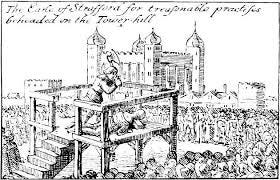
The Framers had specific examples in mind. Thomas Wentworth, the Earl of Strafford, had been executed by parliamentary attainder in 1641 after Parliament concluded that conventional prosecution would not produce the desired conviction. The American colonies had used attainder against Loyalists during the Revolution. The history was recent enough to be vivid.
Alexander Hamilton, defending the attainder clause in Federalist No. 84, called bills of attainder, alongside ex post facto laws, “perhaps greater securities to liberty and republicanism than any [the Constitution] contains.” He named the instruments and the function they had served: “the creation of crimes after the commission of the fact, or, in other words, the subjecting of men to punishment for things which, when they were done, were not punishable” — these had been “in all ages, the favorite and most formidable instruments of tyranny.”
The Framers’ design was structural. They placed the legislative power in one branch and the judicial power in another. The legislature made general rules; the judiciary applied them to particular cases. The bill of attainder violated the separation: it allowed the legislature to act as judge and jury against named individuals, bypassing the procedural protections the judiciary was supposed to provide.
What Section 304 had done to Lovett, Watson, and Dodd was, in this precise structural sense, what the Constitution was designed to forbid.
Justice Black’s Opinion
The Supreme Court ruled 6–2 in Lovett, with Justice Robert Jackson recused because of his prior service as Attorney General. Justice Hugo Black wrote for the majority. Justice Felix Frankfurter, joined by Justice Stanley Reed, concurred on narrower grounds.
Black’s opinion is one of the cleanest statements in American constitutional law of why the federal government may not target named private citizens. The relevant passage:
Legislative acts, no matter what their form, that apply either to named individuals or to easily ascertainable members of a group in such a way as to inflict punishment on them without a judicial trial are bills of attainder prohibited by the Constitution. … When our Constitution and Bill of Rights were written, our ancestors had ample reason to know that legislative trials and punishments were too dangerous to liberty to exist in the nation of free men they envisioned.
Three features of this passage are worth attention.
First, “no matter what their form.” Black explicitly rejected the government’s argument that Section 304 was not a bill of attainder because it concerned appropriations rather than criminal punishment. The argument was that Congress had not punished Lovett, Watson, and Dodd; it had simply declined to pay them. Black was unmoved. The substance of the action was punitive — the destruction of three federal careers through legislative fiat — and the formal vehicle (an appropriations rider) could not exempt it from constitutional scrutiny.
Second, “easily ascertainable members of a group.” The attainder prohibition does not require that the targeted individuals be named in the statute by surname. A law that targets a group so specific that the individuals can be identified — by job, by association, by published views — falls within the prohibition just as a law that names them does.
Third, “ample reason to know.” Black located the prohibition in concrete historical experience rather than in abstract constitutional principle. The Framers had seen attainder used. They saw what it produced. They wrote the prohibition because they remembered.
The Court ordered back pay for all three men. Lovett returned to academia and lived until 1956. Watson returned to Columbia and continued his career into the 1970s. Dodd had the hardest path; the targeting had interrupted a trajectory he never fully recovered, and he died in 1952 at forty-seven, before the political environment that produced his targeting had fully receded. The case bearing his colleague’s name became the foundational modern statement of the attainder doctrine.
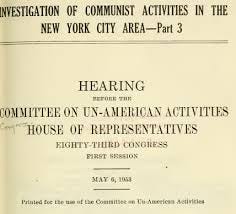
In the next episode, we will discuss how the attainder doctrine extends to two citizens, John Thomas Watkins and Paul M. Sweezy, both of whom were subpoenaed to testify under suspicion of Communism. Why should the government be prohibited from singling out and targeting private citizens?