
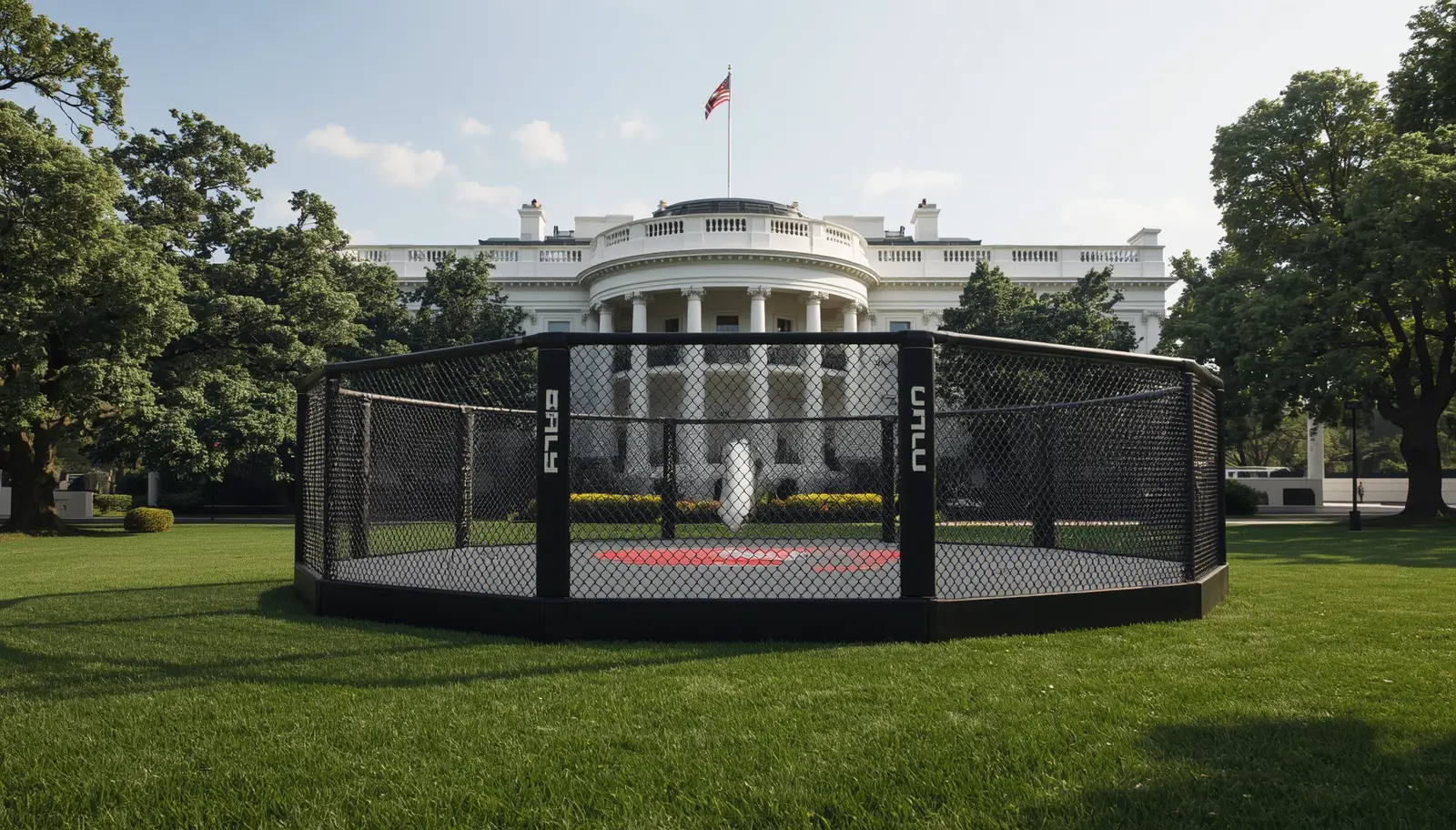
On June 14, the South Lawn of the White House — a patch of grass once reserved for state arrivals, Easter egg rolls, and the occasional Marine One liftoff — will be transformed into a 4,500-seat cage-fighting arena. The event, branded “UFC Freedom 250,” is being staged to commemorate the 250th anniversary of the Declaration of Independence. It will also, not incidentally, fall on President Trump’s 80th birthday. Eight jumbotrons in adjacent parkland will broadcast the bloodletting to an expected crowd of up to 100,000. The headliners — Ilia Topuria versus Justin Gaethje, Alex Pereira versus Ciryl Gane — will trade kicks, knees, and elbows inside a six-foot wire-mesh octagon erected, with apparent earnestness, on the front lawn of the Executive Mansion.
There is no polite way to say what this is. The People’s House is being rented out, in spirit if not in coin, as the set piece for a birthday party masquerading as a national observance. And the entertainment chosen for the occasion is a sport whose central premise is the legal infliction of brain damage on consenting adults. And the term consenting is used very casually—if you’ve ever attended an uneven match, your conscience is immediately assaulted watching closeup the abuses bestowed.
The Mathematics & Inhumanity of Cerebral Insult
Begin with the medicine, because the medicine is not in dispute. A peer-reviewed analysis of 844 UFC bouts found that nearly one in three ended in knockout or technical knockout — a rate of cerebral concussion that outpaces boxing, professional football, and ice hockey. A separate study put the incidence of traumatic brain injury in MMA at 15.9 per 100 athlete-exposures, roughly twice the rate in the NFL and more than seven times the rate in the NHL. Systematic reviews place the overall injury rate as high as 54.5 per 100 athlete-exposures — meaning that, on average, a fighter who walks into the cage walks out hurt. When researchers slowed the tape, they found that in the final 30 seconds before a referee stopped a losing fighter, that fighter absorbed an average of 18.5 strikes, 92 percent of them to the head. After a knockout punch lands, the loser is hit, on average, 2.6 more times before anyone intervenes. The interval between unconsciousness and rescue: 3.5 seconds.
This is not a freak outcome of the sport. It is the sport. UFC fighters wear four-ounce fingerless gloves — roughly a third the padding of a boxing glove — and no headgear. They strike with shins, elbows, and knees as well as fists. Unlike in boxing, a downed opponent may be punched in the face until the referee decides he can no longer “intelligently defend himself,” a standard that, by the data, is met only after roughly 18 additional blows to the skull. Fighters routinely cut 15 to 20 pounds of water weight in the days before a bout and rehydrate hours before stepping in — a practice that, the research shows, leaves the brain dehydrated and more vulnerable to traumatic injury at precisely the moment the punches start. The dehydration is not a bug. It is a feature of how weight classes are policed.
The long-term ledger is grimmer still. Chronic traumatic encephalopathy — the tau-protein neurodegeneration linked to repeated head impacts — has been documented in deceased MMA fighters. Living UFC veterans, including Nam Phan and Gary Goodridge, have shown the slurred speech, memory loss, mood collapse, and cognitive decline that researchers now identify as traumatic encephalopathy syndrome, a clinical precursor to CTE. Dr. Ann McKee, the Boston University neuropathologist whose work forced the NFL to acknowledge the football-CTE link, has testified that MMA carries not only a high concussion rate but a high subconcussive impact rate — the smaller, unremarkable blows that accumulate in training and sparring, and which her research identifies as the principal driver of the disease. UFC’s own chief business officer has been reported as acknowledging suspected CTE in active fighters. There is, at present, no treatment and no cure.
The Economics of UFC
Now consider whom the President has chosen as his anniversary partner. UFC is owned by TKO Group Holdings, a publicly traded conglomerate that just signed a seven-year, $7.7 billion media rights deal with Paramount — $1.1 billion a year, on average, with annual escalators. UFC claims more than 700 million fans and 318 million social media followers worldwide. TKO posted $2.8 billion in revenue in 2024 and is guiding to roughly $3 billion in 2025. Its CEO, Dana White, is among the President’s closest and most public allies, a fixture at his rallies and on his campaign stages. The White House is, in effect, providing a billion-dollar entertainment property with the most valuable backdrop on earth, for free, on the most heavily promoted civic date of the year. The phrase “in-kind contribution” comes to mind. So does “conflict of interest.”
The choice tells us what the administration believes the 250th anniversary of American self-government is for. The Declaration of Independence was, among other things, a long catalogue of grievances against a monarch who staged martial spectacles for his own glorification on grounds the public was forbidden to enter. The men who signed it built a republic whose ceremonial center — a white house on a public lawn — was meant to embody the opposite proposition: that power resides with citizens, that the presidency is a borrowed office, that the building belongs to the country and not to its temporary occupant. To convert that lawn into a cage on the President’s birthday, with a billion-dollar promoter as co-host and 100,000 spectators cheering live concussions, is to invert the symbolism so thoroughly that one struggles to believe it was inadvertent. It is, frankly, the kind of birthday a king would throw.
Leading By Example
One can like UFC — millions of Americans do, and they are not wrong to find skill and courage in the cage — and still recognize that there are venues where a blood sport belongs and venues where it does not. Las Vegas: yes. Madison Square Garden: yes. T-Mobile Arena, the Sphere, the casinos of Atlantic City where Trump himself hosted UFC bouts in 2001: yes. The South Lawn of the White House, six months before a midterm, on the President’s 80th birthday, dressed up as a 250th-anniversary tribute to the founding: no. The Constitution does not forbid it. Good taste, civic seriousness, and a basic regard for the men and women whose brains will be rearranged for the entertainment of the crowd ought to.
The late Senator John McCain, no shrinking violet on questions of American toughness, once called the sport “human cockfighting.” He was right about the literal mechanics of what happens inside the octagon, and he was right that the dignity of public life is diminished when its highest stages are surrendered to it. On June 14, the United States will mark a quarter-millennium of constitutional government by watching grown men strike each other unconscious on the lawn of the building that is supposed to embody the alternative to rule by spectacle and force.
Happy birthday, Mr. President. The country deserved better than a confused shrine to volitional dementia and disability.