And other cool science stuff.
Let’s get the bad news over with. The Patterson-Gimlin film of 1967 — the one with the famous over-the-shoulder glance — is, by most sober accounts, a man in a suit. Bob Heironimus has claimed for decades that the man was him, and costume maker Philip Morris says he sold the relevant materials. So we are not starting from a position of strength. Good.
Now the fun part: what can we salvage?
The “it’s biologically possible” defense.
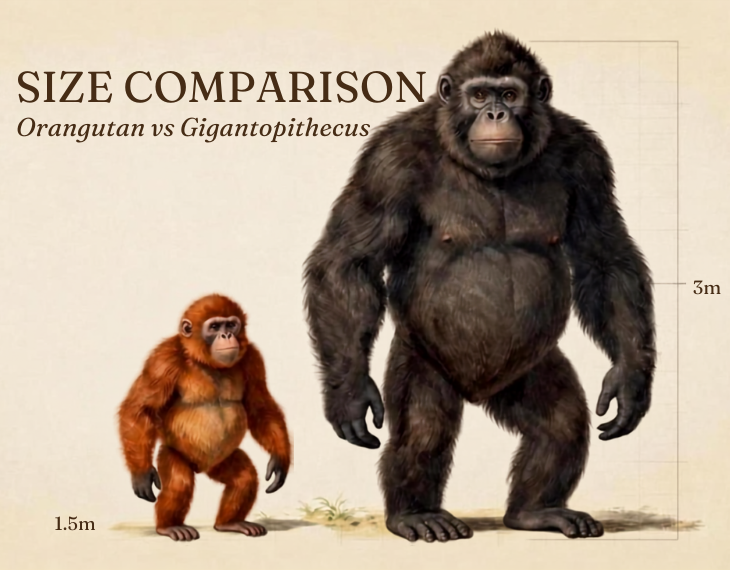
Gigantism is real. Robert Wadlow, the tallest human ever reliably recorded, reached 8 feet 11 inches before his death in 1940, the result of an overactive pituitary gland pumping out growth hormone with no off-switch. The human frame can, under hormonal duress, go genuinely enormous. So a very large primate is not a physics violation. The mountain gorilla already does most of the job — 400-plus pounds of bipedal-ish ape. Oh, and Gigantopithecus, a real extinct ape, may have stood up to 10 feet tall. It went extinct around 200,000 years ago. Probably. (Ominous footstep.)
The “you can’t trust your own eyeballs” defense.
Here’s where the believer gets real help. Humans are genuinely terrible at estimating the size of an unfamiliar object at distance, especially one that triggers a fear response. We judge size by comparing things to known references, and a lone shape in dense forest offers none — no doorframe, no parked car, no fellow human standing beside it for scale. Worse, the brain reliably inflates the dimensions of anything frightening or fast-moving; a startled witness running backward through underbrush is collecting the worst possible data under the most dire conditions around. Add poor light, an obscuring canopy, and a memory that gets revised every time it’s retold, and a 6-foot bear standing upright at 80 yards becomes, by the third campfire, a 9-foot man-beast. So the very testimony that supports Bigfoot is precisely the kind we should least trust on the one detail — size — that makes him Bigfoot.
The “apes did live here” defense.
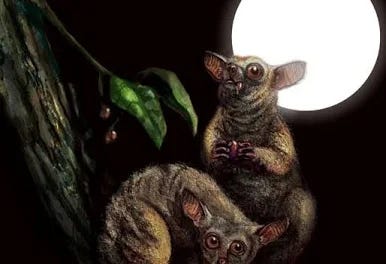
This one’s real, if you squint generously across deep time. North America was genuinely primate country once: true primates colonized the continent about 56 million years ago at the start of the Eocene and flourished here for over 20 million years, including small omomyids and adapoids known from rich fossil beds in Wyoming. They died out as the climate cooled and dried near the Eocene-Oligocene boundary roughly 34 million years ago. A late holdout, the charmingly named Ekgmowechashala—a five-pound, roughly one-foot-tall primate—lingered on the American Plains before vanishing. The catch for cryptozoologists: every one of these was tiny, none was an ape, and the gap between them and any hypothetical Sasquatch is tens of millions of years wide. The continent has a primate resume. It just stops well short of “large hairy hominid, recent.”
The “why we want it” defense.
I’m told roughly 13% of Americans tell pollsters Bigfoot is real, and that’s less gullibility than psychology. Humans are pattern-detection machines tuned by evolution to spot a face or a lurking predator in ambiguous shadow — a false positive costs you a startle, a false negative costs you your life. Pareidolia plus a blurry trail-cam plus a deep ancestral wish that the woods are not yet fully mapped equals a folk belief that simply refuses to die.
The verdict.
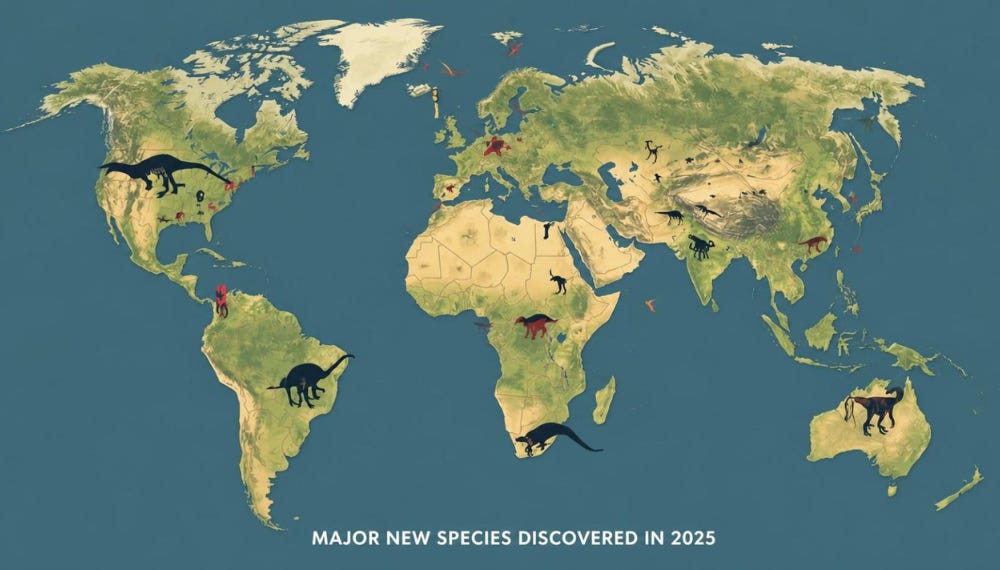
No body, no bones, no scat, no DNA — and in an age of 8 billion smartphones, that absence is loud. But last year, new dinosaur species were discovered worldwide, on average, once per week! And “biologically conceivable, psychologically inevitable, empirically absent” is a far more interesting epitaph than “fake,” and it leaves the forest just dark enough. I would add the statistical likelihood of ape gigantism and the concept of social desirability bias, but I have to get up early for an Ivory-Billed Woodpecker stakeout—eBird sent an alert—a bunch of novice birders struck gold on their first independent outing!
If science is your jam, here’s some additional reading (I summarize it).
Zhang, Y., Westaway, K.E., Haberle, S. et al. The demise of the giant ape Gigantopithecus blacki. Nature 625, 535–539 (2024). https://doi.org/10.1038/s41586-023-06900-0
Zhang et al. analyze 22 fossilized remains of Gigantopithecus individuals, offering insight into their diet, habitat, and reasons for going extinct—mostly presumed to be habitat loss and competition. They lived in forests of China, ate berries, and faced environmental encroachment.