Plaintiffs deadline to opt in to $7.8B is today. A series on agribusiness, food sovereignty, and public health.
For millions of smallholder farmers across Africa, a packet of seed is the difference between a fed family and a hungry one. So when those seeds come with strings attached, the consequences ripple far beyond the field — into nutrition, debt, and public health.
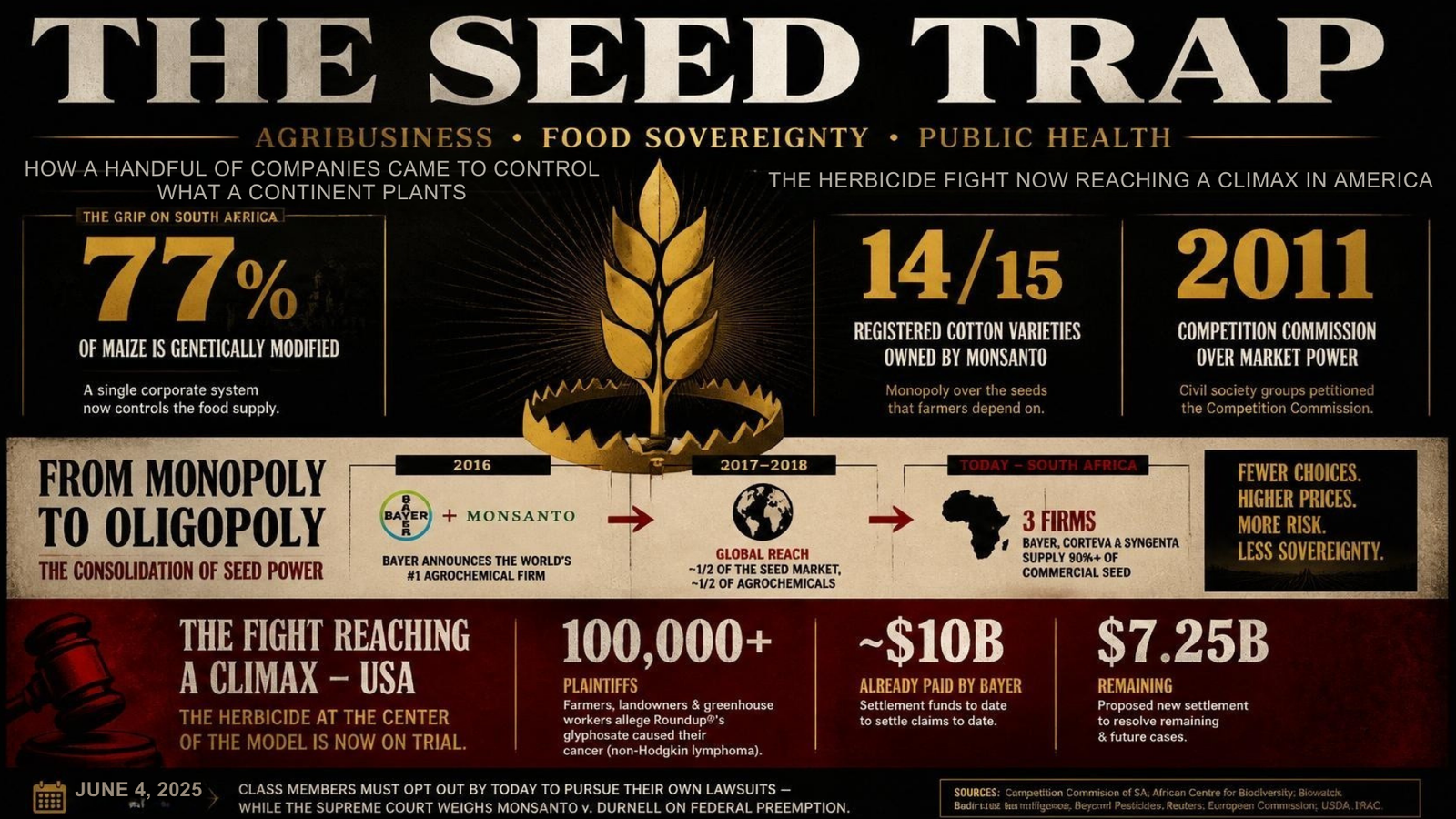
In South Africa, the continent’s GMO epicenter, the agrochemical giant Monsanto built a commanding position in the seed market. About 77% of maize — the national staple — became genetically modified, and Monsanto held a near-total monopoly in the GM seed industry. In cotton, it once owned 14 of 15 registered varieties.
The business model is what worries public health advocates. Seeds are patented, so they can’t legally be saved or replanted, and once farmers adopt GMO seeds and their companion herbicides, switching back becomes difficult. Donated or discounted GM seeds often require expensive inputs — fertilizers, pesticides, herbicides — that must be purchased from the same corporation, creating a cycle of dependency. Back in 2011, South African civil-society groups petitioned the Competition Commission to investigate Monsanto’s market power.
What’s changed since then
The name on the door is different now. Bayer acquired Monsanto in 2018 for $63 billion, and “Monsanto” today survives mostly in legal filings. The merged company became the second-largest agrochemical firm in the world, holding roughly a third of the global seed market and about a quarter of the agrochemical market.
The monopoly concern hasn’t vanished — it has rearranged into an oligopoly. In South Africa, Bayer, Corteva, and Syngenta now collectively supply more than half of all commercial seed. That market is projected to reach about $802 million in 2025 and climb toward $985 million by 2030. The core dynamic from a decade ago — a few foreign giants controlling staple-crop genetics, bundled with proprietary herbicides — remains intact. It’s just spread across several names instead of one.
The promises haven’t always held up either. A USDA report found that Monsanto’s drought-tolerant maize performed poorly on both yields and adoption compared with conventionally bred varieties — a reminder that the premium price didn’t always buy a premium harvest.
The fight that’s reaching a climax right now
The most active front today isn’t in Africa — it’s in American courtrooms, over the herbicide at the center of the whole model: glyphosate, sold as Roundup.
- More than 100,000 plaintiffs have filed suit alleging Roundup’s glyphosate caused their cancer, primarily non-Hodgkin lymphoma.
- Bayer has already paid roughly $10 billion to settle claims, and has proposed an additional settlement of about $7.25 billion to resolve the bulk of remaining and future cases.
- The U.S. Supreme Court heard arguments in Monsanto v. Durnell in April 2026, weighing whether federal labeling law shields the company from state failure-to-warn claims — a ruling that could reshape the entire litigation.
There’s a deadline today: class members in the proposed settlement have until June 4, 2026 to opt out if they want to pursue their own lawsuits. That makes this a natural pause point.
In Part Two, we’ll pick up after the deadline — what the opt-out numbers signal, where the Supreme Court case is headed, and what any of it means for the African farmers who never had a seat in those courtrooms but live with the same products in their fields.
Sources include Greenpeace Africa, the African Centre for Biodiversity, Reuters, and Bayer’s own litigation disclosures. Figures current as of June 2026.